Top 10 Smart Circuit Breakers for Global Buyers
Choosing the right Smart Circuit Breaker is no longer a simple price comparison. Global buyers must examine safety performance, communication protocols, installation design, and long-term support. A device that works smoothly in a European 230V panel may not suit another market’s voltage, wiring method, or certification requirements. Small details matter.
This guide reviews ten leading options for residential, commercial, and light industrial applications. Each product is considered through practical criteria, including rated current, overload protection, remote monitoring, energy measurement, app stability, and compatibility with platforms such as Wi-Fi, Zigbee, or professional building systems. We also examine enclosure quality, DIN-rail mounting, firmware updates, warranty terms, and manufacturer documentation. Clear datasheets are valuable. Independent testing is better.
No single breaker fits every project. Some models provide excellent energy data but offer limited third-party integration. Others have strong hardware yet confusing mobile applications. That difference becomes obvious when a buyer checks a live load beside a distribution board or investigates an unexpected trip at midnight. Our comparison aims to separate useful innovation from attractive marketing. It is not perfect; regional availability and software changes can affect the results. Buyers should still verify local requirements and consult a qualified electrician before installation. A careful decision usually begins with the panel, the load, and the installer—not the product photograph.
Smart Circuit Breakers: Definition, Components, and Operating Principles
A smart circuit breaker is a protective switching device with sensing, processing, and communication functions. It detects abnormal current, voltage, temperature, or leakage conditions. Unlike a conventional breaker, it can report electrical data and operating events. The word smart can mislead, however. Intelligence does not replace correct circuit design.
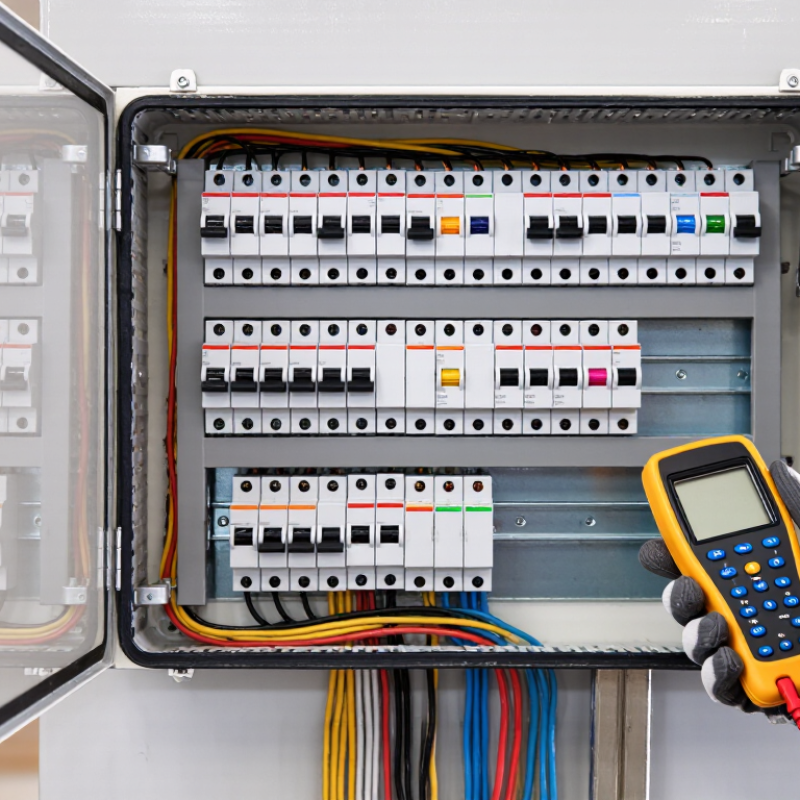
Its main components include fixed and moving contacts, a trip mechanism, arc-extinguishing chamber, terminals, sensors, and an electronic control unit. Some models also include a display, communication interface, and manual test button. During normal operation, current passes through closed contacts. Sensors continuously measure selected electrical conditions. If a dangerous value exceeds its configured threshold, the control unit activates the trip mechanism. The contacts separate rapidly, while the arc chamber limits and cools the electrical arc.
For global buyers, practical inspection matters more than attractive software. Check rated voltage, breaking capacity, pole configuration, temperature range, and enclosure protection. Confirm that the communication method suits the installation environment. Remote switching is convenient, but it is not magic. A network failure should not prevent basic protection from operating. Installation should follow applicable local standards and manufacturer instructions. Testing may reveal unwanted trips caused by poor coordination or incorrect settings. That detail is easy to overlook. Proper commissioning, documented settings, and periodic inspection support reliable performance.
Key Features to Compare Before Choosing a Smart Circuit Breaker
Top 10 Smart Circuit Breakers for Global Buyers
Before choosing a smart circuit breaker, compare protection, connectivity, and measurable operating value. The IEA’s Energy Efficiency 2023 report estimates that buildings consume about 30% of global final energy. Accurate circuit-level monitoring can therefore reveal wasted power, overloaded circuits, and unusual nighttime consumption.
Start with the fundamentals. Check rated current, breaking capacity, voltage range, and trip curves. IEC 60947-2 provides an important reference for many low-voltage applications. A higher rating is not automatically safer. That assumption fails when cable size and installation conditions are ignored. Look for adjustable protection only when qualified technicians can configure it correctly.
Communication features need equal attention. Compare Wi-Fi, Ethernet, cellular, and local-control options. A device should still trip safely if cloud access disappears. Check sampling frequency, energy measurement accuracy, event records, and exportable data. In practical commissioning, installers also examine terminal temperature, enclosure space, manual override, and alarm response time. Small details matter.
Cybersecurity is easy to overlook. NIST’s Cybersecurity Framework 2.0 emphasizes governance, protection, detection, response, and recovery. Buyers should ask about encrypted communication, role-based access, firmware updates, and audit logs. Data ownership must be clear. Remote switching sounds convenient, but accidental commands can create operational risk. Test the failure modes before purchase. Some specifications look impressive on paper, yet field performance may vary with network quality, heat, and installation skill.
Top 10 Smart Circuit Breakers for Global Buyers
Key Features to Compare Before Choosing a Smart Circuit Breaker
The chart compares ten commonly used nominal-current options for low-voltage smart circuit breakers. The current values follow widely used IEC circuit-breaker rating series from 6 A to 63 A. Actual availability, pole configuration, breaking capacity, voltage rating, communication protocol, protection functions, and local certification should be verified before purchase. The correct rating must be selected according to the calculated load, cable capacity, installation method, and local electrical code.
Top 10 Smart Circuit Breakers for Different Global Applications
Top 10 Smart Circuit Breakers for Different Global Applications
Global buyers need application-based selection, not attractive specifications alone. The IEA’s Electricity 2024 report forecasts global electricity demand will grow by about 3.4% annually through 2026. That growth increases the value of accurate protection, remote monitoring, and faster fault isolation.
For apartments and houses, compact smart breakers can track overloaded kitchens, air conditioners, and battery chargers. Office buildings need scheduled switching and circuit-level energy records. Factories require stronger interruption ratings, event logs, and coordination with motor protection. Data centers should prioritize rapid alerts, redundant monitoring, and stable operation during maintenance. Hospitals need selective protection for life-support and diagnostic circuits.
Solar-plus-storage systems require compatibility with bidirectional power flows. Electric-vehicle charging sites benefit from load balancing across several chargers. Farms need dust-resistant enclosures and dependable communication over long distances. Remote facilities often need cellular or low-power connectivity. Small retail sites benefit from simple dashboards and tamper alerts.
The UNEP Global Status Report for Buildings and Construction 2024 states that buildings consume about 32% of global energy and produce roughly 34% of global carbon emissions. Smart breakers can reveal waste, but they cannot repair poor wiring or careless settings. That limitation matters. Buyers should verify voltage, pole configuration, short-circuit ratings, communication protocols, and local certification requirements. IEC-based testing offers useful reference points, yet regional installation rules still differ. In practice, a breaker that performs well in a clean office may struggle in a humid greenhouse. Field conditions are often underestimated. Qualified electrical professionals should confirm protection coordination before commissioning.
Safety Standards, Certifications, and Regional Compatibility
Top 10 Smart Circuit Breakers for Global Buyers
Safety Standards, Certifications, and Regional Compatibility
Smart circuit breakers combine overcurrent protection, energy monitoring, and remote control. Their safety depends on more than app features. The IEA’s Electricity 2024 report projects global electricity demand to grow by about 3.4% annually through 2026. This expansion increases the need for reliable protection in homes, factories, and charging installations. Buyers should check whether a product follows IEC 60898-1 for household use or IEC 60947-2 for industrial applications. North American projects may require UL 489 or CSA C22.2 No. 5. European installations commonly require CE compliance, but the CE mark alone is not a safety certificate.
Regional compatibility also includes voltage, frequency, wiring systems, enclosure ratings, and communication rules. Wireless models may need electromagnetic compatibility and radio approvals in the destination market. A breaker rated for 230 V may not suit a 120 V panel. Small details matter. Certification documents should show the exact model, rated current, breaking capacity, and test standard. A familiar mistake is treating one regional approval as universal acceptance. It is not. Requirements can change by installation type and country.
Tips: Ask for current test reports, declaration documents, and local approval evidence. Confirm neutral wiring and busbar dimensions before ordering. Check whether cloud data is stored legally in the target region. If a supplier cannot explain trip curves or short-circuit ratings clearly, pause the purchase. My own review point is simple: connectivity looks impressive, but dependable mechanical protection must come first.
Installation, Connectivity, Maintenance, and Buyer Considerations
Selecting the top 10 smart circuit breakers requires more than comparing app features. Installation quality matters first. Confirm panel compatibility, rated current, breaking capacity, neutral requirements, and available space. A certified electrician should verify torque settings with a calibrated tool. One loose terminal can create heat behind a quiet enclosure.
Connectivity deserves equal attention. The International Energy Agency’s Electricity 2024 report projects global electricity demand to grow by about 4% annually through 2026. More connected loads mean better visibility, but also more network dependence. Choose breakers supporting secure local operation, event logs, and clear outage behavior. Wireless range can weaken inside metal distribution boards. Test connectivity from the actual installation point, not the showroom.
Tips: Ask for firmware support periods, data-export options, and documented cybersecurity controls. Keep manual switching available. It is easy to overvalue dashboards. A useful system should show circuit temperature, trip history, and load changes without confusing alarms. Maintenance should follow the equipment maker’s schedule and NFPA 70B practices, including inspection, thermal scanning, and functional testing where applicable. The U.S. National Fire Protection Association identifies electrical maintenance as a risk-control practice, yet small installations often skip records. That is an uncomfortable gap. Keep a dated log beside the panel. Also, check local certification requirements before importing equipment; compatibility claims are not the same as approval.