Why Is Powder Detergent Better for Your Business?
Powder Detergent can be a practical choice for businesses that buy, store, and use cleaning products at scale. The American Cleaning Institute’s economic impact research puts the U.S. cleaning products industry’s contribution at roughly $60 billion annually. That figure covers the wider industry, not powder detergent alone. Still, it shows the commercial scale behind everyday cleaning products.
For laundries, hotels, care facilities, and retailers, the business case often comes down to cost per wash, storage, and handling. Powder is typically sold in compact, stackable packs, and bulk formats can reduce packaging and freight costs per dose. A dry product also avoids shipping water, though the real savings depend on supplier pricing and delivery distance. Small details matter: a damp storeroom can turn a tidy pallet into clumps and customer complaints. Not every site benefits equally.
The American Cleaning Institute estimates that a typical U.S. household washes about 300 loads each year, illustrating how frequently laundry products are used. Its guidance supports careful dosing and product selection, but it does not prove powder is best for every machine or fabric. Brian Sansoni, the institute’s senior vice president, has publicly emphasized cleaning’s role in everyday health; that point is paraphrased here, not presented as a verbatim quotation. Business buyers should test dissolution, stain removal, and residue under their actual wash conditions. A low invoice price can still disappoint. Powder Detergent may offer a strong operational fit, but the right choice deserves a measured trial.
What Powder Detergent Is and How It Cleans
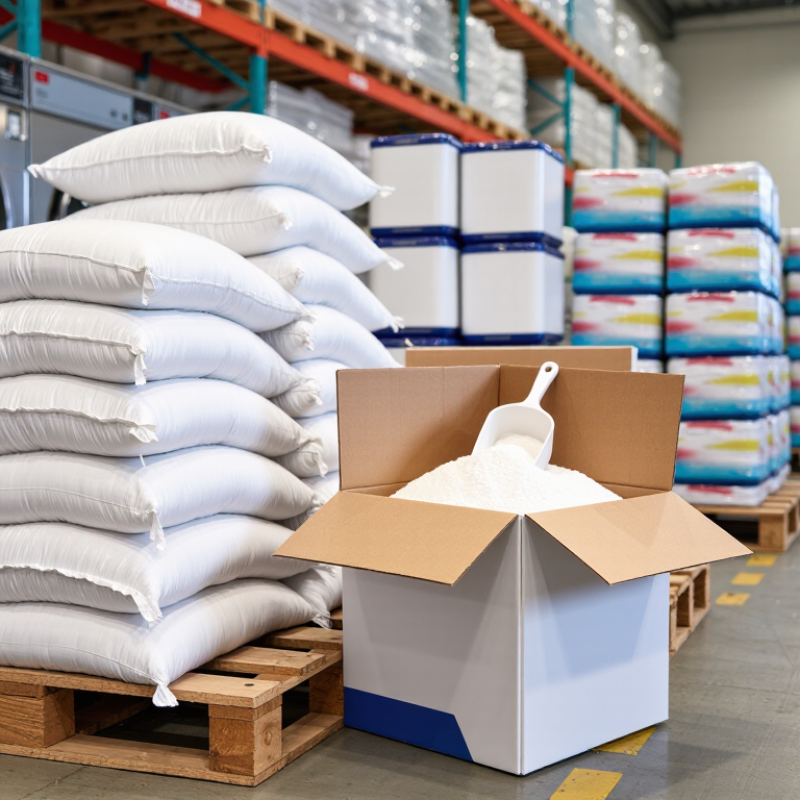
Powder detergent is a dry blend of cleaning agents, commonly including surfactants and water-softening builders. Surfactants help loosen oily soil from fabric; builders bind minerals that can interfere with cleaning. In the wash, water activates the ingredients, which help lift and suspend dirt until rinsing. The American Cleaning Institute’s laundry-care guidance explains these ingredient roles. Powder can be practical for bulk storage and measured dosing, though performance depends on the formula, water temperature, and machine.
Water matters. The U.S. Geological Survey reports that about 85% of the United States has hard water, where calcium and magnesium can affect washing. Builders help manage those minerals, but overdosing may leave residue, especially in cool cycles or short washes. Powder is not magic. A test load is useful before setting a standard dose for staff or customers.
Tips: Follow the package dose for load size and water hardness. Keep powder dry, use a level scoop, and check that it dissolves fully in your machine’s cycle. If residue appears on dark fabric, reduce the dose or try warmer water when the care label allows. A little trial and adjustment is normal.
Why Powder Detergent Helps: Water Hardness and Cleaning
Calcium and magnesium in hard water can interfere with cleaning. Many powder detergents contain builders that help manage these minerals, supporting surfactant performance. Water-hardness categories shown are USGS classifications; very hard water is above 180 mg/L as calcium carbonate.
Source: U.S. Geological Survey (USGS), water-hardness classification. Values show category upper thresholds, not detergent-performance measurements.
How Concentrated Formulas Can Reduce Cost per Wash
Why Is Powder Detergent Better for Your Business?
How Concentrated Formulas Can Reduce Cost per Wash
For a laundry business, the useful number is not price per bag. It is cost per correctly dosed wash. A.I.S.E.’s detergent Product Environmental Footprint rules assess products by a defined wash, supporting comparisons based on use rather than package size. The arithmetic is simple: a 5 kg pack costing $15 gives 100 washes at a 50 g dose, or 15 cents per wash. A concentrated formula using 25 g per wash gives 200 doses from the same weight. Check the label and cleaning performance before assuming the lower dose is equivalent.
Tips: Track actual dose, water hardness, and rewash rates for a week. If a 5 kg concentrated pack costs $18 and performs at 25 g per load, its detergent cost is 9 cents per wash. Small scoop errors add up. So does overdosing.
Powder can also be easier to store in bulk, but damp rooms may cause clumping, and not every product suits every machine or soil level. That part deserves a real trial, not a guess. Compare price per wash using the supplier’s stated dose, then test representative loads and record results. A.I.S.E.’s Product Environmental Footprint guidance provides a structured industry method for comparing detergent impacts per wash; your own measured cost still depends on local water and laundry conditions.
How Powder Detergent Simplifies Storage and Shipping
Powder detergent can simplify storage because it usually contains less transport water than a ready-to-use liquid. That can mean more product fits into a given shelf or pallet area, depending on the formula and package size. More room matters. A small stockroom can hold reserve cartons without blocking access to daily-use inventory.
The dry format also avoids some concerns associated with liquid leakage. Staff can stack sealed cartons on stable pallets and label each layer with the product name and lot details. Keep cartons off damp floors and away from sinks, loading doors, and humid walls. Moisture can cause clumping, which may affect dispensing. Not ideal. A basic receiving check helps: inspect seals, carton corners, and any signs of dampness before storing new stock.
Shipping can be simpler when packages are compact and less prone to leaking during ordinary handling. Smaller cartons may also be easier to count and move by hand, though package weight still matters. Compare the packed dimensions and gross weight with your storage racks, delivery limits, and staff handling routines before choosing a format. Powder is not automatically easier in every operation. Dust can escape from damaged packaging, and poorly planned stacking creates extra work. The practical benefit comes from matching pack sizes to real order volumes and storage conditions.
Why Is Powder Detergent Better for Your Business? — How Powder Detergent Simplifies Storage and Shipping
| Business consideration | Powder detergent | Liquid detergent | Practical impact |
| Water shipped with the product | Typically a concentrated dry product, so the detergent itself contains little or no added water. | Usually contains water as part of the formulation. | A dry formulation can reduce the amount of water transported per unit of detergent; actual shipment weight depends on the formula and packaging. |
| Packaging and handling | Commonly packed in bags, cartons, or tubs, depending on the product. | Commonly packed in bottles, jugs, or other liquid-compatible containers. | Packaging format affects pallet layout, handling, and storage efficiency. Compare the actual case dimensions and pack count before purchasing. |
| Leak and spill risk | Cannot leak as a liquid, though torn or poorly sealed packaging can spill powder. | Containers can leak if damaged, improperly closed, or mishandled. | Powder can avoid liquid leakage during transit, but secure seals and suitable packaging are still important. |
| Storage conditions | Should be kept sealed and dry; moisture can cause caking or affect product flow. | Should be stored according to the product label; temperature extremes may affect some liquid formulations. | Both formats need appropriate storage. Dry conditions are especially important for powder, while liquid products need protection from unsuitable temperatures. |
| Dose measurement | Usually measured by scoop or another method specified on the label. | Usually measured with a cap, dispenser, or dosing system. | Staff training and clear dosing instructions help control usage and maintain consistent results with either format. |
| Dissolving and wash performance | Dissolving performance depends on the formula, water temperature, and washing conditions. | Dissolving and wash performance also depend on the formula and washing conditions. | Check product directions and test the detergent with your equipment and typical wash loads before standardizing a purchase. |
General comparison only. Product formulation, packaging, storage requirements, and performance vary; consult the product label and supplier specifications.
Which Business Uses Benefit Most from Powder Detergent
Powder detergent often fits laundromats, hotels, care facilities, and uniform services, where staff handle repeated, predictable loads. UN Tourism’s World Tourism Barometer reported 1.3 billion international tourist arrivals in 2023, 34% more than in 2022. That rebound points to renewed pressure on hotel laundry operations, though visitor numbers alone do not prove detergent demand. For properties washing towels and bed linen daily, dry powder can be easier to store in bulk and portion by load than ready-to-use liquid. Less water shipped in the product can also mean less weight to move.
Useful in busy rooms.
Uniform rental operators and laundromats may value powder’s long storage life and straightforward stock control, especially when deliveries are infrequent. A scoop, a labeled dosing chart, and a dry shelf can make routines easier to check. But powder is not an automatic cost saver. Damp storage can cause clumping, and short, cool cycles may leave residue if the formula does not dissolve well. The American Cleaning Institute’s guidance on detergent use emphasizes following product directions and matching dosage to load conditions. That matters in commercial settings, where water hardness, soil levels, and machine capacity vary. Test a small batch of typical loads first; the result can be less tidy than the sales claims suggest.
What to Assess When Choosing a Powder Detergent Supplier
Choosing a powder detergent supplier means checking consistency beyond the sample bag. Ask for recent batch specifications, including active content, moisture level, particle size, and storage-life data. These details affect dosing, flow through filling equipment, and performance in your actual water conditions. Request a certificate of analysis for each batch, then test samples on your own machinery. A powder that pours neatly in a laboratory may still bridge in a humid warehouse. Small detail, costly headache.
Check how the supplier controls raw-material changes, production records, and delivery schedules. Ask for traceability documents and a clear process for handling out-of-spec batches. Packaging also deserves scrutiny. The OECD’s Global Plastics Outlook reports that only 9% of plastic waste was recycled globally in 2019. That figure does not prove every plastic pack is avoidable, but it makes packaging material and end-of-life claims worth verifying. Ask for pack weights and supporting evidence, not just sustainability language. I would not treat a polished certificate as proof of reliable supply; real batch records and repeat trials matter more. The right choice depends on your equipment, storage conditions, and customers’ dosing habits.