Choosing a drum hand pump is not merely a matter of matching threads and fittings. Global buyers face different liquids, drum materials, workplace conditions, and delivery expectations. A pump that performs well with light oil may struggle with syrup, cleaning chemicals, or thick lubricants. Small details matter.
“Start with the liquid, then choose the pump,” says Daniel Mercer, an industrial fluid-transfer consultant with experience supporting drum equipment buyers. His advice sounds simple. It is also easy to overlook. Many purchasing teams focus on price, shipping speed, or appearance before checking chemical compatibility and flow requirements.
This guide presents seven practical buying tips for selecting a drum hand pump with greater confidence. It considers construction materials, viscosity, discharge volume, drum openings, sealing performance, maintenance, and supplier support. Each point connects to real purchasing decisions, such as moving a 20-liter solvent container or dispensing heavy grease from a 200-liter steel drum.
There is no universal best pump.
That is worth remembering.
A manual pump should feel stable during repeated use. Its handle should not flex excessively, and the outlet should direct liquid cleanly into the receiving container. Buyers should also review product data instead of trusting vague phrases like “industrial quality.” Those words can hide important limitations.
This article does not promise a perfect choice every time. Product specifications can be incomplete, and operating conditions may change after purchase. However, careful questions can reduce avoidable mistakes. The right drum hand pump should match the liquid, container, workload, and user—not just the advertised price.
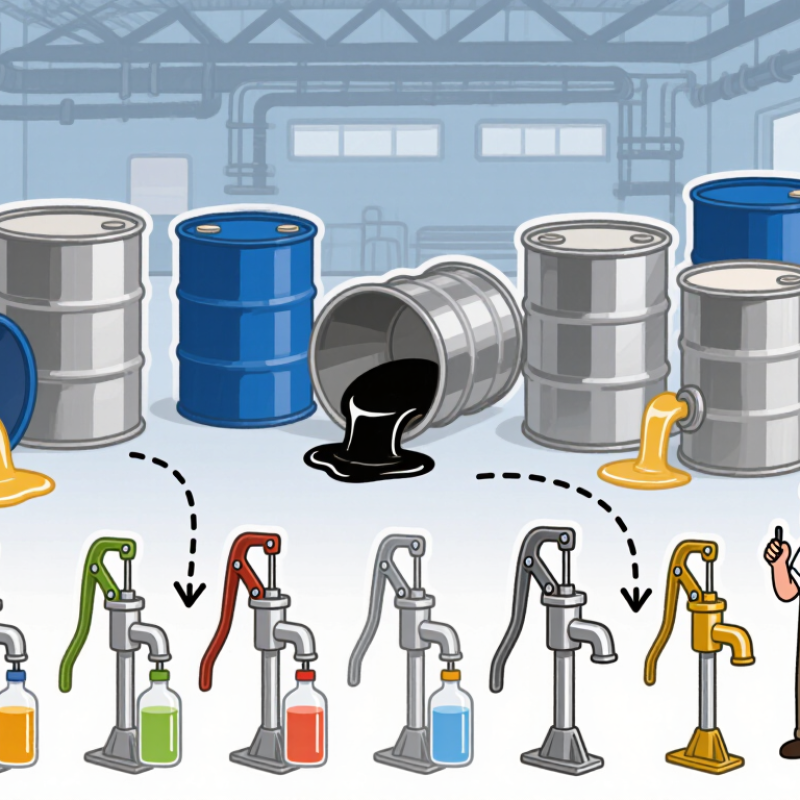
Before choosing a 7 drum hand pump, define the drum precisely. Drum sizes, openings, and bung threads can vary by region. Measure the opening and confirm the internal depth. A pump that fits a standard container may fail on a narrow-neck drum. Check whether the drum is steel, plastic, or lined. Material compatibility matters.
Then identify the fluid and its condition. Record its viscosity, temperature, density, and chemical compatibility requirements. Water-like liquids need different pumping behavior than thick oils or concentrated solutions. Review the safety data before selecting seals, tubes, and hoses. Do not rely on appearance alone. Some fluids look harmless but can damage ordinary seals. That assumption deserves a second look.
Define the transfer task in practical terms. Estimate the volume needed per operation, the required flow rate, and the discharge distance. A short hose may work beside a workbench, while a longer hose can increase resistance. Consider the operator’s strength and the number of drums handled daily. Smooth action is useful. Consistent output is better. In field evaluations, buyers sometimes focus on purchase price and overlook cleaning access. That can create hidden delays. Test the pump with the actual drum, fluid, and temperature whenever possible. Small differences can change the result.
7 Drum Hand Pump Buying Tips for Global Buyers
When selecting a drum hand pump, compare the wetted materials with the stored liquid. Polypropylene suits many mild acids, alkalis, and water-based solutions. HDPE offers good chemical resistance and practical impact strength. Stainless steel handles oils, fuels, and many industrial fluids, but it may react with certain chlorides or aggressive chemicals. Material choice is never universal.
Check every wetted part, including the tube, piston, seals, and discharge spout. A pump body may resist the liquid while its seal swells or cracks. PTFE seals often support demanding chemical service, while elastomers require closer review. Temperature changes matter too. A liquid that seems harmless at room temperature may become more aggressive when heated.
Tips: Request a compatibility chart and the liquid’s safety data sheet. Confirm concentration, temperature, viscosity, and exposure time. Test a small sample when the application is unfamiliar. Do not rely on color or appearance. A transparent liquid can still damage plastic. Consider UV exposure, outdoor storage, and end-of-life recycling requirements. I have seen buyers focus on the barrel material and overlook the seal, which became the weakest point. No chart is perfect. Supplier guidance helps, but real operating conditions deserve a final check.
| No. | Buying Tip | Key Specification to Check | Recommended Material Options | General Chemical Compatibility | Environmental Consideration | Buyer Action |
|---|---|---|---|---|---|---|
| 1 | Identify the fluid before selecting the pump. | Chemical name, concentration, temperature, viscosity, flash point, and solids content. | Use the wetted-part material as the primary selection factor: PP, HDPE, PVDF, 316 stainless steel, or aluminum. | Compatibility varies significantly by concentration and temperature. For example, dilute acids may be suitable for certain plastics, while strong oxidizers or solvents can require specialized materials. | Avoid relying only on generic labels such as “chemical resistant.” Obtain a compatibility confirmation for the exact fluid and operating conditions. | Request a written material compatibility statement or test data. |
| 2 | Compare the wetted materials, not only the outer housing. | Tube, piston, barrel, valve, discharge spout, gaskets, and hose materials. | PP and HDPE: many aqueous chemicals; PVDF: stronger chemical resistance; 316 stainless steel: many oils and solvents; PTFE: broad resistance for seals. | PTFE generally offers broad resistance, but its mechanical performance and seal design still matter. 316 stainless steel can be attacked by chloride-rich or strongly reducing environments. | A single incompatible gasket can cause leakage even when the main tube material is suitable. | Ask for a complete wetted-parts list, including seal compounds. |
| 3 | Match seal material to the chemical and temperature. | Seal type, compression, temperature range, and resistance to swelling or embrittlement. | PTFE: broad chemical resistance; EPDM: commonly used with water-based fluids; FKM: often suitable for many oils and hydrocarbons, subject to chemical limits. | EPDM is generally unsuitable for many petroleum-based fluids. FKM is not universally suitable for concentrated caustics, strong amines, or some polar solvents. PTFE has excellent chemical resistance but may require careful mechanical design. | Seal failure can create leaks, worker exposure, soil contamination, and unplanned maintenance. | Specify the seal compound separately from the pump body material. |
| 4 | Check drum and container fit. | Opening size, thread type, dip-tube length, drum depth, and adapter range. | Plastic adapters are lightweight and corrosion resistant; metal adapters can provide greater mechanical strength where compatible with the fluid. | A chemically suitable tube can still be unsafe if the adapter thread leaks or the dip tube contacts an incompatible container lining. | A secure seal reduces vapor release, spills, and contamination during transfer. | Measure the container opening and depth before ordering. |
| 5 | Evaluate flow rate and operating effort. | Displacement per stroke, approximate flow rate, viscosity capability, and maximum lift. | Rigid PP, HDPE, PVDF, or stainless-steel tubes can be selected according to chemical load and mechanical requirements. | High-viscosity fluids require more effort and may need a larger displacement design. Abrasive solids can accelerate wear in valves and piston assemblies. | Correct sizing reduces excessive pumping, leakage risk, and operator fatigue. | Compare tested flow data using a fluid with similar viscosity. |
| 6 | Consider temperature, UV exposure, and outdoor storage. | Operating temperature, storage temperature, sunlight exposure, impact resistance, and embrittlement risk. | PVDF and 316 stainless steel are often selected for demanding chemical environments; HDPE and PP are lightweight but require temperature and UV checks. | Chemical resistance can decrease as temperature increases. Plastic components may soften, creep, or become brittle outside their rated range. | For outdoor use, verify UV stabilization and protect the pump from prolonged direct sunlight when required. | Confirm both chemical and temperature ratings for every wetted component. |
| 7 | Plan for cleaning, maintenance, and safe disposal. | Disassembly, replacement seals, flushing method, drainability, spare-part availability, and end-of-life handling. | PTFE and stainless-steel components can support repeated chemical service when properly designed; polypropylene and polyethylene parts may be economical for dedicated applications. | Do not mix residues from incompatible chemicals. Cleaning agents must also be compatible with the pump materials and the stored fluid. | Drain and decontaminate the pump before maintenance, recycling, transport, or disposal in accordance with local regulations. | Choose a design with replaceable seals and document the cleaning procedure. |
Note: Material compatibility is application-specific. Always verify the exact chemical concentration, temperature, exposure time, pressure, and seal material using a current compatibility chart, safety data sheet, or qualified technical review before use.
When global buyers assess a drum hand pump, design should match the liquid, container, and working environment. Tip one is to check drum-thread compatibility carefully. A loose fit creates leaks and wastes time. Tip two is to inspect the tube length, handle shape, and sealing points. These details affect control during repeated transfers. Tip three is to choose materials that resist the intended liquid. Compatibility charts help, but real operating conditions can differ.
Flow rate needs practical testing, not only catalog figures. Tip four is to compare output per stroke with the required transfer volume. A high advertised rate may depend on fast, tiring operation. Tip five is to consider liquid viscosity and temperature. Thick fluids usually move more slowly. Short trials with a filled drum reveal problems better than calculations alone. I once underestimated hose resistance. That mistake changed my purchasing checklist.
Operating efficiency includes effort, maintenance, and service life. Tip six is to examine whether the pump produces a smooth flow without excessive handle force. Tip seven is to confirm replaceable seals, clear instructions, and reliable technical documentation. A simple design is often easier to clean and repair. However, “simple” does not always mean efficient. Buyers should record stroke counts, transfer time, and operator fatigue during evaluation. Regional safety requirements and approved material standards should also be verified before shipment.
When buying a drum hand pump, safety features deserve more attention than flow rate alone. The International Labour Organization estimated 2.93 million work-related deaths worldwide in 2023. A small transfer tool still deserves serious control.
Check for a non-sparking design when handling flammable liquids. Verify grounding and bonding instructions. Look for pressure relief, secure drum fittings, and a sealed inlet. Certification must match the destination market. CE, UKCA, or other approvals do not automatically cover every application. For hazardous areas, confirm suitable explosive-atmosphere compliance.
Ask for test reports, material declarations, and traceable certificates, not just printed logos.
Maintenance needs are often underestimated.
Inspect the hose for soft spots, the handle for play, and seals for swelling or cracks. Do it before every shift. The U.S. Bureau of Labor Statistics recorded 5,283 fatal workplace injuries in 2023, showing why routine checks cannot be treated as paperwork. Confirm chemical compatibility using the fluid’s safety data sheet and the pump’s material specifications.
Keep a simple log with inspection dates, leakage observations, and replacement parts. In practice, operators may skip this during busy loading periods. That is a weakness worth admitting. A pump that feels smooth can still hide a damaged check valve. Use the manufacturer’s maintenance interval, but shorten it when dust, heat, corrosion, or frequent cycling increases wear.
When purchasing a drum hand pump internationally, supplier reliability matters as much as pump performance. I have seen low quotes become expensive after freight, packaging, and replacement parts were added. Start by checking the supplier’s operating history, factory evidence, response speed, and quality documents. Ask for a current product drawing. Confirm wetted materials, flow rate, thread size, seal type, and drum compatibility. Request a sample before placing a large order. The handle should move smoothly, without leaks or unusual resistance. Small details matter.
Tip: Compare the full purchase value, not only the unit price. Include tooling, sample charges, export packing, inland transport, ocean or air freight, insurance, duties, and local delivery. Ask for a written quotation with currency, validity, lead time, payment terms, and delivery responsibility. A cheap offer may exclude critical costs. Request photos of packed cartons and labels. For repeated orders, calculate expected service life and spare seal availability. This gives a more realistic cost per use.
Tip: Verify performance and consistency before shipment. Use a simple inspection checklist covering quantity, dimensions, materials, operation, and packaging condition. An independent inspection can help when the order is large or the supplier is unfamiliar. Keep test records and written approvals. Do not rely on polished videos alone. I once underestimated after-sales communication; replacing one small seal took longer than expected. That experience changed my buying process. Now I ask how complaints are logged, who pays reasonable replacement freight, and how quickly technical answers arrive. No supplier is perfect. Clear evidence is better than confident promises.
![]() |
Need Help? Call Us 203-740-1877
|
We're ready to help identify, size and spec your pumps, filters |
Pumps, Parts, and Equipment – Guidance Included
103 Hempel Drive
Wolcott, CT 06716
Telephone: 203-740-1877
Toll Free Fax: 866-523-1693
Email: sale@rewritertool.com